The Market Square of Perception
Beyond the Keyhole of Personal Desire
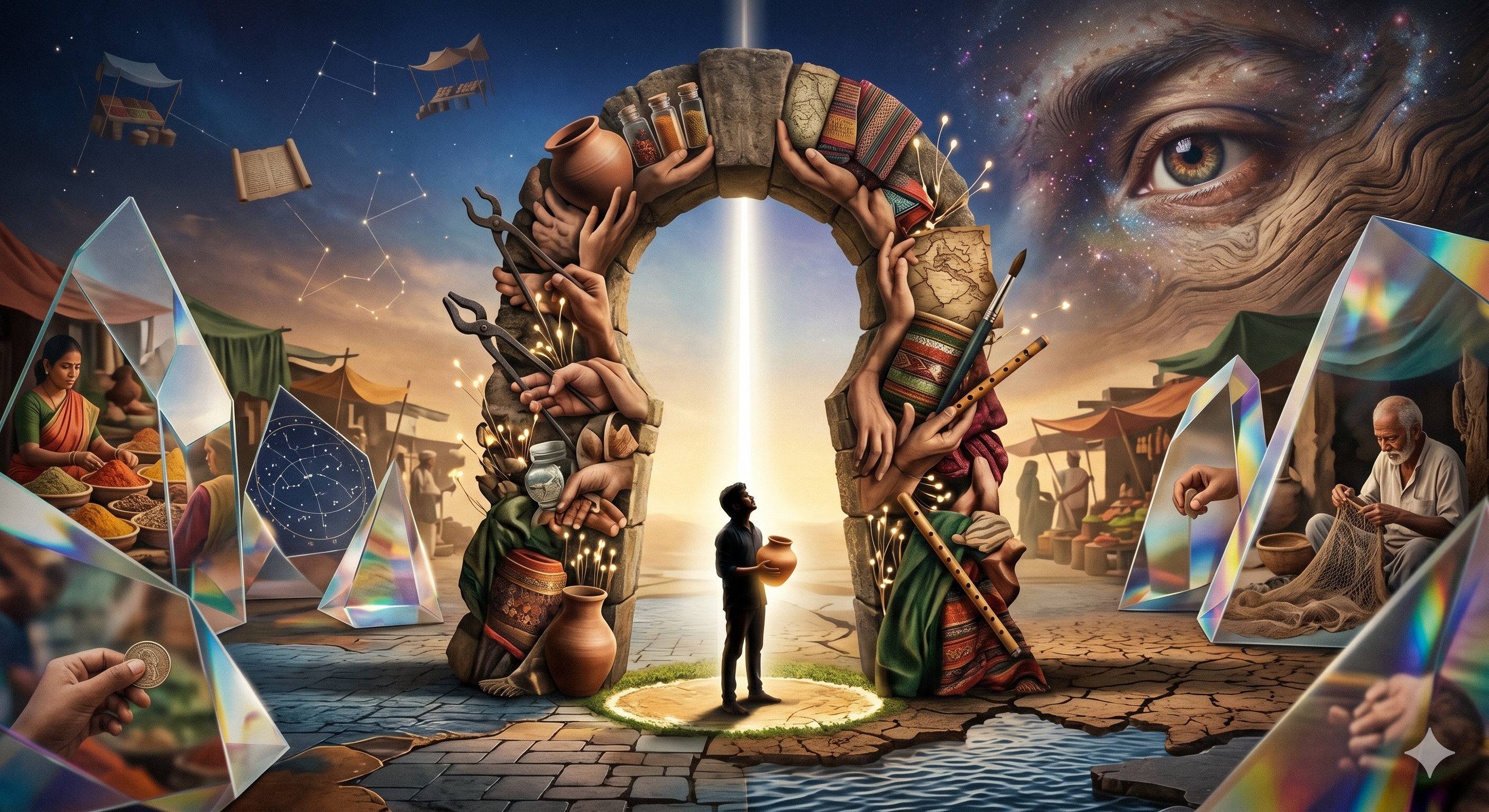
This story on the relentless pursuit of novelty hits on a very real modern paradox: the line between enriching exploration and overwhelming overstimulation
We all seek new experiences, but can this constant search for novelty become overwhelming? We are told to embrace new things, but is there a limit? This question reminds me of a story about a great sage named Anambara. His name echoed across continents; scholars from Rome, philosophers from Greece, and mystics from China undertook vigorous journeys to absorb his wisdom. His wisdom was not of books, but of life itself. His style was distinct, his insights profound
Yet, Anambara, a great Guru, who mentored the world, never taught his own son, Amogha. Instead, he sent Amogha to a distant Gurukula to be shaped by another’s hand. Years later, when his son Amogha returned, Anambara wanted to test his wisdom. He gave him a simple task: "Go to the marketplace and come back." Amogha found the task pointless and returned in an hour. "It's just a market, father," he said
The next day, Anambara told him, "Go to the market again. But this time, look closer." Amogha went and spent the entire day. He returned and described all the different sections: the spice lanes, the textile stalls, the metalsmiths, and the manuscript sellers. He had mapped out the whole ecosystem
On the third day, the sage gave the same order: "Go to the market." Confused but obedient, Amogha went. He stayed from the morning rush, through the afternoon lull, to the evening flurry, until he was left standing alone in the dark, empty square
That night, post-dinner, they had a long talk. Amogha spoke about the things that interested him, like the skilled artisans and musicians. But his father asked, "What about the things you didn't like? What did you ignore?" Amogha replied with his youthful honesty, "Father, I can't like everything. The blacksmith's rough tools and the boring clay pots didn't interest me, so I just ignored them."
A knowing smile appeared on Sage Anambara’s face
"My son," he said, "the mind naturally seeks novelty and comfort, filtering out what it deems irrelevant. But a collection of isolated parts does not make a world. Wisdom is not about accumulating endless new sensations, nor is it about passively observing a chaotic flood of information until you are overwhelmed
True wisdom is recognizing the interconnected system. The boring clay pot holds the water that cools the blacksmith; the blacksmith forges the tools that harvest the spices; the spice trade funds the musicians you so admire. Nothing exists in isolation
To only seek what you find novel or pleasant is to see the world through a tiny keyhole. But, to understand how the ordinary and the extraordinary interact, to see the unseen threads that balance the whole, is to throw open the doors of perception. This is what makes us truly adaptable. Eternal growth is not the endless chase for the new, but the expanding awareness of how all things — both the appealing and the mundane — fit together in a functional, ever-changing balance"